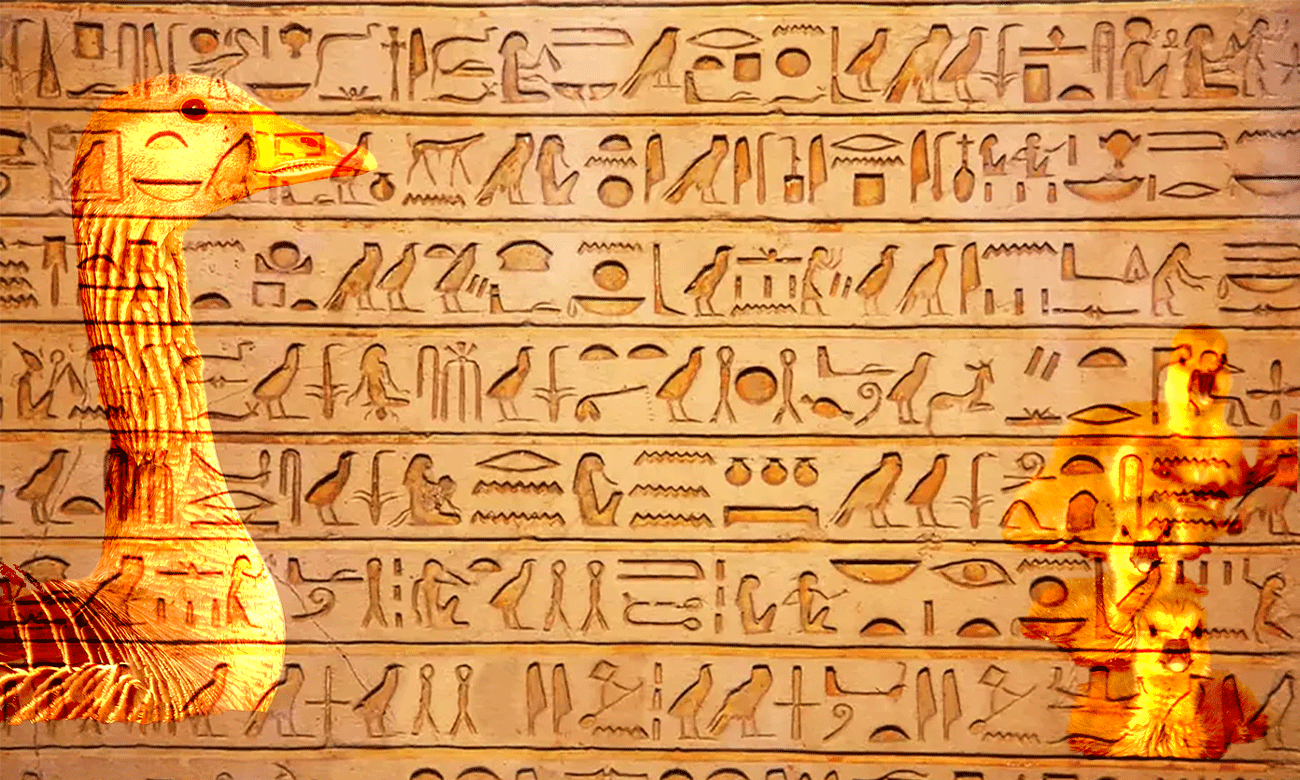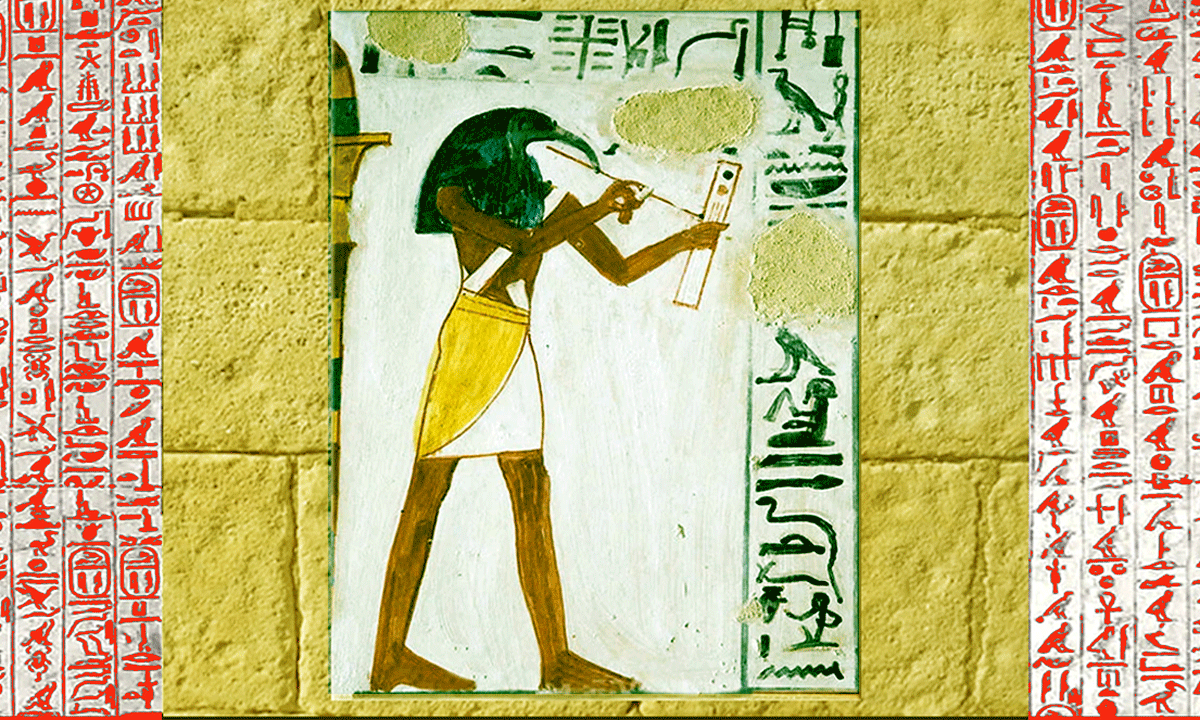
This four-handed essay inaugurates a new series. Ten years ago, Alain Aillet posted the original version of this article. This time, it is signed AAXE, that is to say Alain and Xavier. We start our ping-pong with the hieroglyphs, the first writing that translates into signs the divine word, the Golden Tongue, the gentle verbiage of the language of the birds.
Divine Word
How to correctly decipher the various planetary hieroglyphs? The question does not date from yesterday and the Rosetta Stone was only able to provide a local response, immense certainly, but limited to Egyptian hieroglyphs.
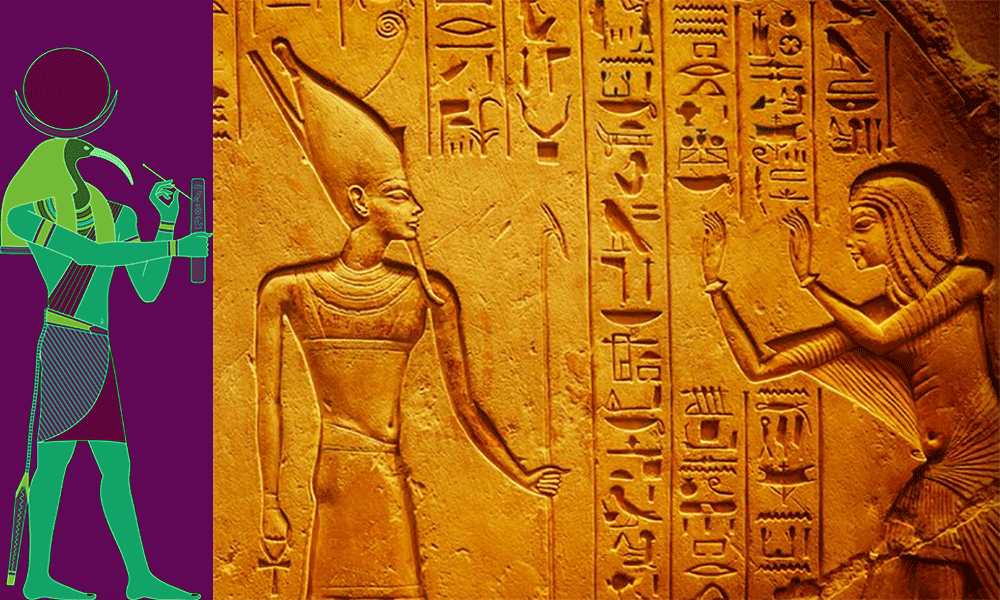
The Egyptian hieroglyphic script is a figurative writing system: the characters that compose it represent various objects — natural or produced by Man—such as plants, figures of gods, humans and animals, etc.
The Egyptians themselves named their script ‘mataw nacaɾ’, divine word. (wikipedia)
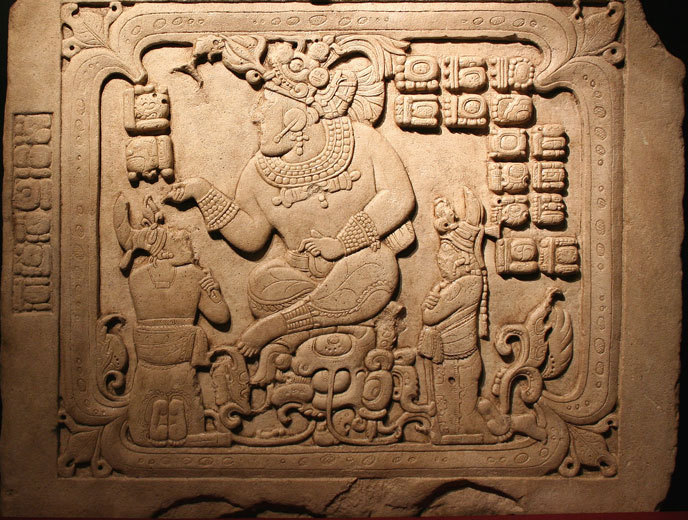
This type of character is not exclusive to the ancient Egyptians, of course. Hieroglyphs are found in the four corners of the globe, as many representations with diverse styles, more or less explicit. But all of them state a primary truth,
the divine word of the former gods.
In fact, our alphabet owes them a lot. In his research, the team of Klaus Dona has found in different countries the same writing on stones or terracotta objects.
For lack of a better name, they named it pre-Sandritish. They could have named it pre-Celtic or pre-Mayan… They found similarities between this writing and other, undeciphered hieroglyphs, such as those from Easter Island.
Proto-Sanskrit
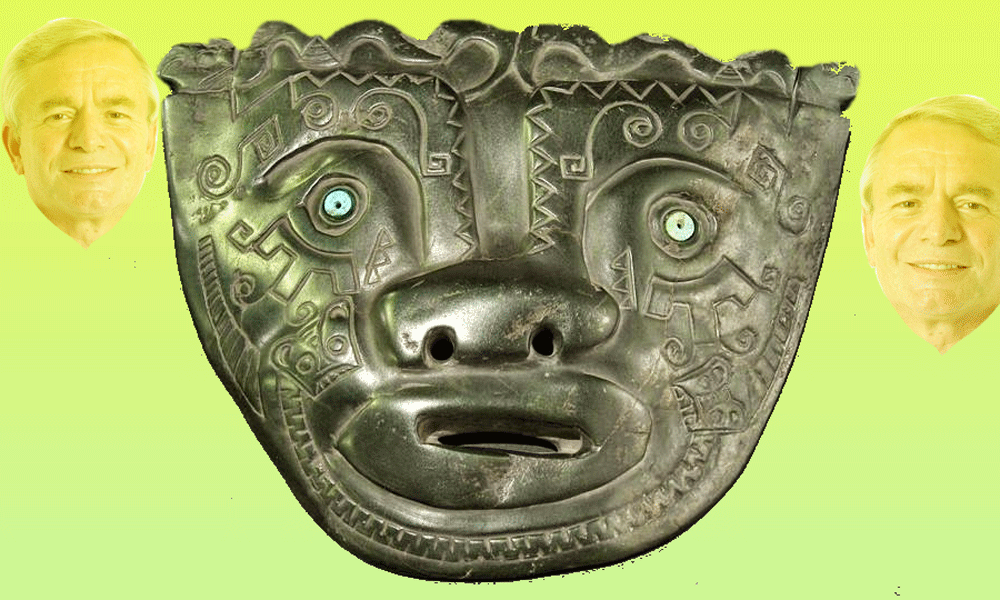
Professor Kurt Schildmann was the president of the Society of German Linguists. He was the first to decipher the texts of the Indus valley, mainly written in archaic phonetics or proto-Sanskrit.
 Since 1977, he has always claimed that the even more fascinating texts of Burrow Caves (Illinois, USA) are also Proto-Sanskrit. Several of the glyphs in Montana, USA, correspond to the Burrows glyphs of the caverns, crop circles, cymatic symbols and petroglyphs from all over the world. (source)Julie Ryder
Except that, perspicacious, Erhard Landmann found much more. What he read about the stones is quite astounding.
Erhard Landmann is a polyglot German scholar. He allowed the study of ancient languages to make a considerable leap. His discoveries are of a nature to fundamentally modify the study of hieroglyphs, wherever they come from.
Leafing through a Spanish-Maya dictionary, Landmann saw that the hieroglyph was called vuothap or buothap in Maya. Immediately the click occurred at the sound level.
Landmann recognized High German buchstap which became Buchstabe in modern German. This word means letter or character. Hieroglyphs are both letters, sounds, and also images. Second brilliant intuition of Landmann.
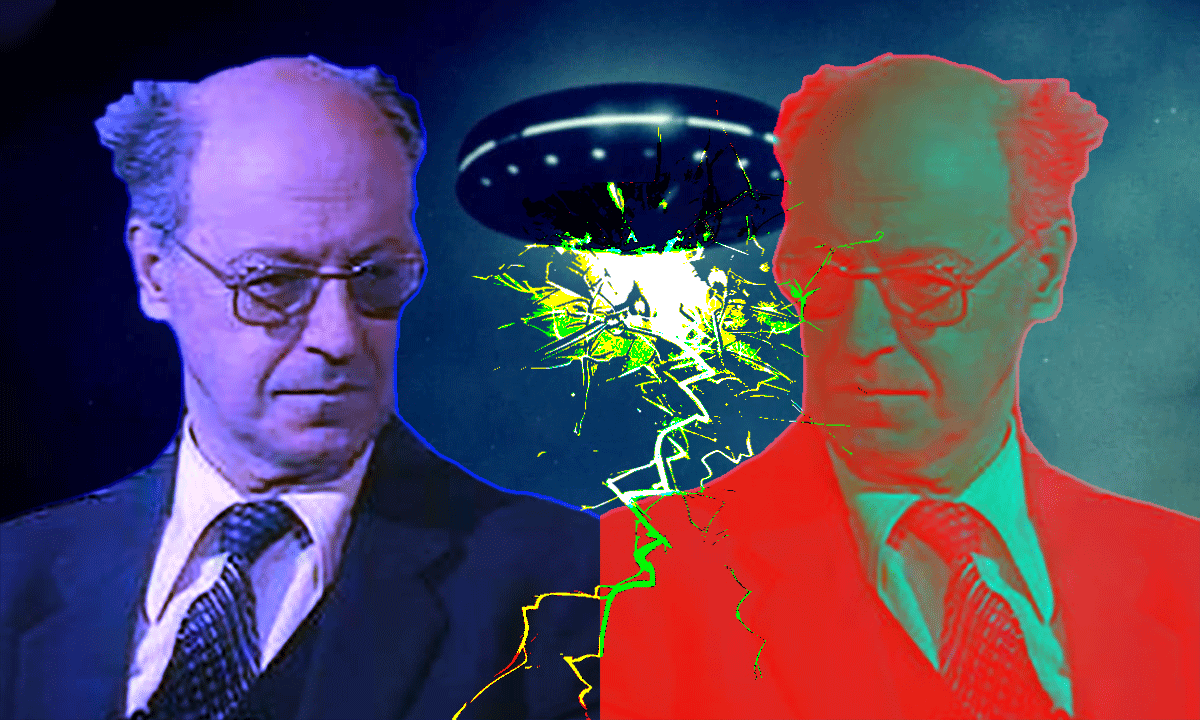
Albert Slosman
Although this alleged intuition is not the extreme curiosity that led him to read the books of Albert Slosman (1925-1981) where the latter explains in length, broadly and cross the three possible readings of Egyptian hieroglyphs. Slosman has found so many remarkable subtleties in the careful examination of ancient Egypt, one can only be surprised by the lack of recognition that current Egyptology shows him — while unscrupulously appropriating his finest finds.
This is what happens when one is not part of the seraglio and has not sworn allegiance to any thesis master who will not fail to appropriate the glory of your discoveries. A gloomy fate that also awaits Séguin post-mortem.
Mayan hieroglyphs
Under his eyes, the indecipherable Mayan hieroglyphs became in an instant a comic in relief, perfectly understandable. To the images of characters or animals, are added signs or emblems that are letters or groups of letters. Sacred. The intelligible words thus formed have for the most part a spiritual meaning, which Landmann could immediately interpret in Old German.
And he deduced from it the disturbing consonance between the Quiché language of the Mayans and an ancient form of German.
If Landmann was able to relate sound to writing, it is thanks to the Mayan language, still alive, whose sounds he recognized. Other hieroglyphic languages, such as Hittite or ancient Egyptian, can no longer play this role, because they are dead languages. In this case doubly dead, because deprived of sound.
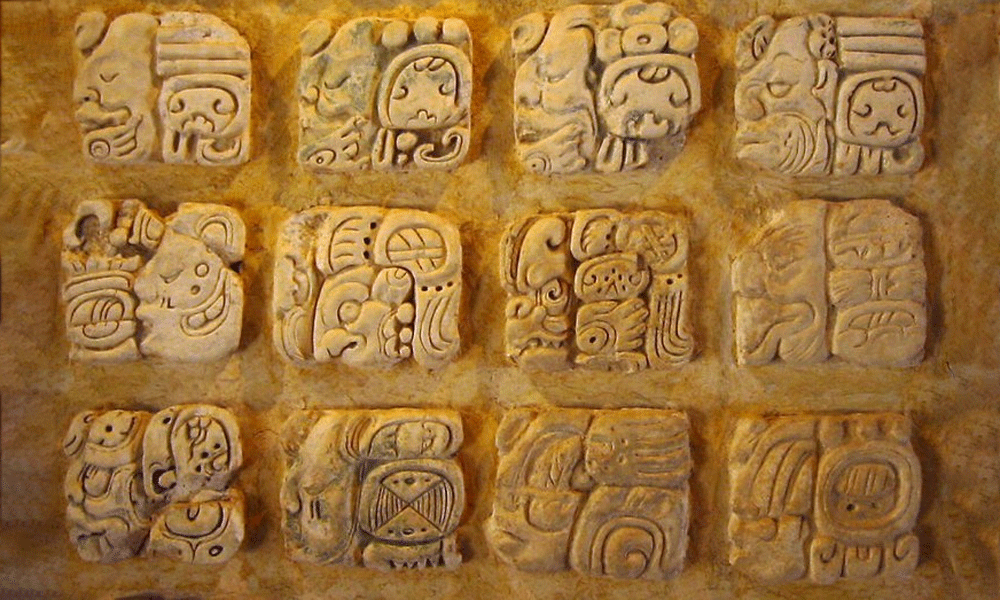
Don’t worry…
Still the Quiché? Xavier Séguin has already pointed out the parallel between this same Quiche language and ancient Gaelic.
Cuchùlann has everything from Celtic: blond and very tall, he wears a beard like the Tuatha. With his companions from the Snake People, he comes from another world. Or Cuchùlann, accompanied by his clan of blond giants, is said to have arrived from the east, from distant Europe. The Aztecs call him Quetzalcoatl, the Feathered Serpent. The Quichés, on the other hand, call him Gucumatz. Now, like the name of Cuchùlann, that of Gucumatz is formed by two sandwich words: gumatz, which means snake, and cu, which means bird.
This grammatical peculiarity, extremely rare, is common to these two peoples, which is already notable. Let’s add that among the Mayas, Gucumatz is called Kukulkan, which is pronounced like Cùchulainn. So? What to conclude? Is the warrior hero of the Celts the peaceful god celebrated by the Mayans? Would he have lived a double life? Of course, in the Mayan legends, we do not find this version, because it is mine. Which I share with whoever wants. (read more)
Comics Images
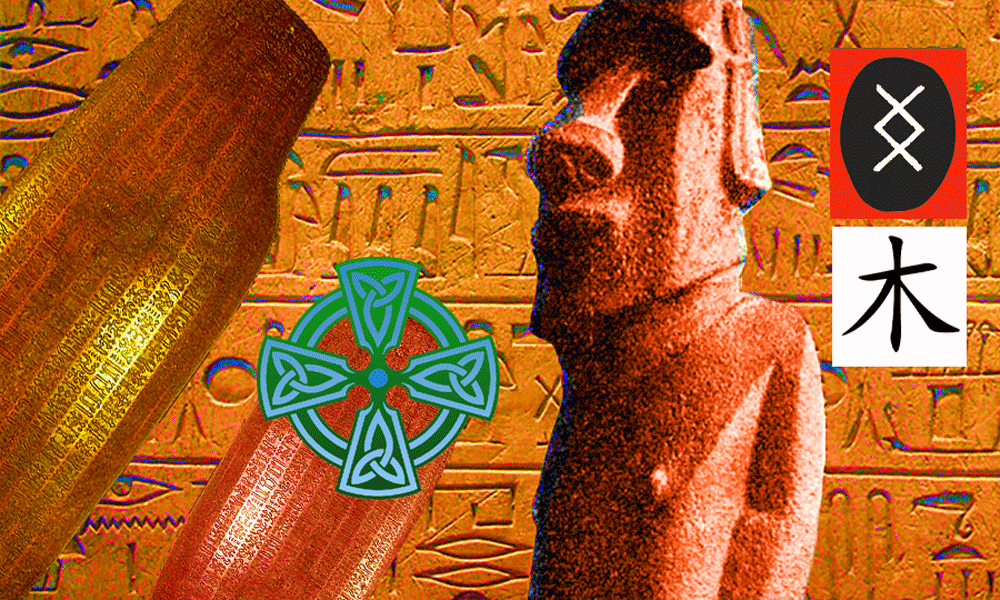
On a background of Egyptian hieroglyphs, here are rongorongo from Easter Island, a Celtic cross, a mohaï from Easter Island as well, a Viking rune and a Chinese ideogram. We will evoke these different representations, because they do not show letters in the current meaning of the term, but rather images from comics …
Sound First
In the beginning was the Verb. Sound is at the origin: the oral alone is sacred, the written is impure. Very many ancient languages were not written, the Celtic languages for example. The Nordic languages are related to them, those of the Vikings and other circumpolar populations used runes which can be considered as a kind of writing.
Yet the runes do not transcribe the sounds of a language. These are not characters like letters, but rather ideograms like those of Chinese.
Ideograms
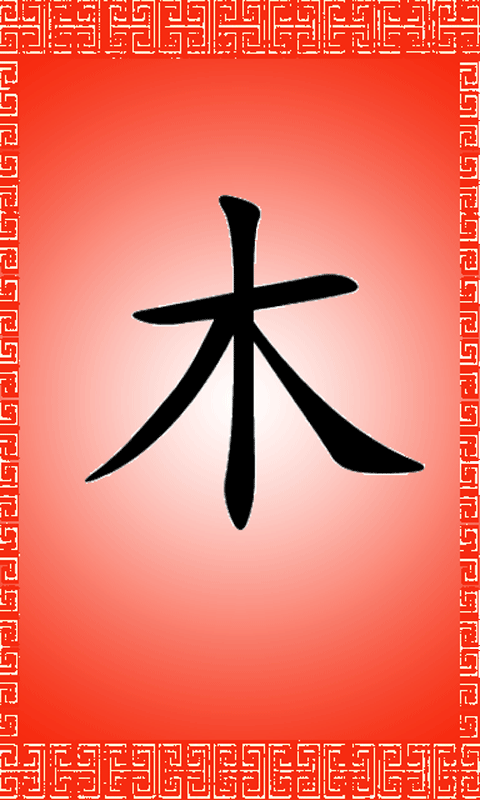 Chinese ideograms, on the other hand, put writing before sound. They are understood throughout China, from Beijing to Shanghai, but they are pronounced very differently depending on the regions and provinces.
The restaurants that offer steam dishes are called Dim Soum, steamers, in Beijing, while in Hong Kong they are called Yam Tcha, which means drinking tea.
Yet the ideograms are the same for these two names which however have neither the same meaning nor the same pronunciation. Thus any Chinese, regardless of their origin, can be understood by ideograms, and not by their language.
There are in China a good dozen languages and a host of dialects. Unity has therefore been achieved through ideograms, understood everywhere.
Rongorongo
Like runes or ideograms, hieroglyphs are not letters but the images of a comic. One of these old comic books remains nevertheless indecipherable: the tablets of Easter Island.see the image above
Rongorongo is the name given to a system of signs engraved on wood that could constitute either a writing or a mnemonic means for recitations of myths or genealogies.
Discovered on Easter Island in 1864 by the missionary Eugène Eyraud, these inscriptions resisted all attempts at decipherment. The carbon-14 datings carried out in 2024 on a wooden tablet show that the inscriptions date from the mid-15th century, thus before the discovery of Easter Island by the West.
The signs of tablets present the appearance of homunculi and stylized animals, sometimes plants, often geometric or fantastic shapes, and objects that are difficult to interpret. Twenty-six wooden objects bearing rongorongo inscriptions were collected in the second half of the 19th century and are now preserved in museums and private collections.
These twenty-six objects would count some 15,000 glyphs comprising 400 distinct signs. (wikipedia)
The rongo-rongo tablets of Easter Island are full of letters, words, poorly formed certainly, but which can easily be deciphered by whoever looks at the image first. It is in this way that the mysteries of the Tarot of Marseille must be felt. The interiorization of the image is the sacred path. The interiorization of sound is the door to Eden. Our past no longer belongs to specialists, but it is returned to the entire species.
The Verb
In the beginning was the Word and the Word was god, says the gospel of John. The word god comes from thieut or thiot, thot, tuath, touth, etc., which means the people in old high German. We are taught at school that god comes from the Greek theos, who also gave Zeus, but they omit to tell us that theos comes from thiot and means people.
Zeus is a mischief. He is not the god of the gods, he is the power of the people. When I think that the extreme right is trying to recover Erhard Landmann! On the contrary, this guy was closer to communism… It is true that the extremes touch each other: further proof, if needed, that the circle is the perfect figure, universal, first and final.
Or rather the spiral, which is the circle in 4D. The circle in 3D is a globe; if we add the dimension of time to the circle, it becomes spiral.
Spirals
Golden Spiral
The Spiral of Incarnation
Anthills
In any case, Landmann understood the kicks in the anthill of Egyptology. The relevance of hieroglyphic translations has often been questioned in the past. Albert Slosman distinguished three levels of interpretation of the Egyptian hieroglyphs: trivial, symbolic and sacred. But Egyptologists did not notice this interesting advance. Despite all his science, Slosman was not lucky enough to belong to the seraglio…
Ah the serail! The anthill! Protected area, guarded hunting ground, private land reserved solely for club members. Current science is withering and killing itself with the task, scattered as it is among a thousand groups that study the same things but hide their work under different formulations.
Modern Math and Formal Logic
In the 70s, a new discipline appeared, which was called modern maths. The name remained for them.
The pure literary ones found more panache and interest in it than the old maths, which had never found favor in their eyes. In 1967-68, the students of section A, pure literary, learned that they would not have math at the baccalaureate. Delighted, they made paper cups during math classes, totally useless.
These literary people thought they were rid of maths forever. In a bachelor’s degree in philosophy, they were trained in formal logic. With astonishment, they recognized modern math. Strictly compliant, these two disciplines had nevertheless adopted different signs. Thus the specialists of one completely ignored what was happening in the other…
All Heirs
Beyond the very different writing systems, there are the sounds, very similar. There are the phonemes that respond from one language to another. While linguistics prefers the written word, Landmann chooses sound and image. He notices what jumps in his ear: in languages with different roots, from very distant countries, there are phonemes, words, sentences that sound the same. Exactly the same.
We saw it for Cuchulainn and Kukulkan, for Baalbek and Balbec, for Perun Aska and Peru Nazca. Xavier Séguin call it the language of Goslings. The track that I follow, a little different, would rather be the language of origins, the one taught to us by the astronaut gods of Hyperborea. In this perspective, it is impossible to give the German language more importance than others.
Some might believe, and misuse it, that the people who speak this language are the sole heir of the former gods. We know where this bullshit could have led not so long ago. Pan-Germanism is dead and cannot be reborn. So? The language of the Goslings pulls our ears: with a name like that, Landmann can only be chauvinistic.
Language of the Goslings
If Old High German was able to preserve many sounds of the first language, is it not the same for Breton, Hindi, Slavonic, Mayan, Hebrew, Greek, Latin? The quest for origin is far beyond parochial quarrels. The artificial divisions between peoples, sciences, parties, incomes, young people, old people, skin colors, languages — thank you Babel! — are the pure products of a Machiavellianism well anterior to Machiavelli: divide and rule.
What matters, behind these sounds of a supposed first language, is the permanence of a story that we find everywhere trace: ours. What matters is the quest for our origins to which you are all invited. It is to play at decrypting secret messages, always ignored, which nevertheless tingle in the sounds and phonemes of all the dialects of the world.
Thus the first language joins the Language of Goslings. Friends of the world, to your languages! Search, dig, speak, learn. As Jean de La Fontaine wrote so well, “Work! Take pains! It’s the bottom that is missing the least.”
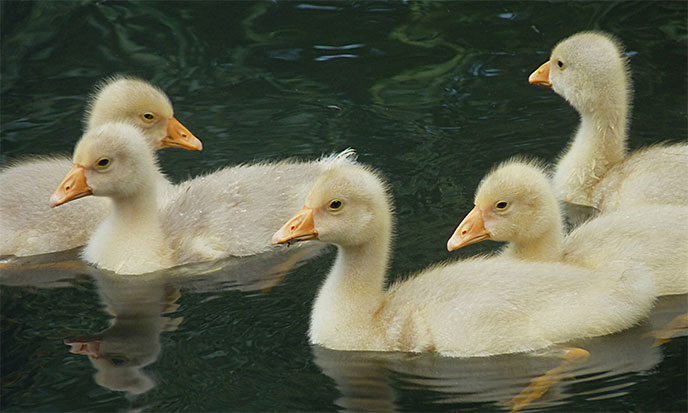 Look at these goslings how cute they are
Alone in the world
And how deep it is, that background! It goes back to dinosaurs. By the way, what language did they speak, those birds? The first Hebrews had a god, formidable flying dragon, fierce bloodthirsty and cannibal dictator. They understood it when they talked to them. And they had better, otherwise they would have to go over to the pot!
At the end of this study, what should be concluded? Just this: sound takes precedence over everything else. We think that there was originally only one universal language that could be written in a thousand ways. But it was not written like today, with letters, words, sentences. It was not evoked as images. And if the foreigners did not understand these particular images, everyone could comment on them through sound, which was understood by all.
But we have fallen very low. Nowadays, languages separate us. Isolation is the disease of the century. Will it still be the one of the next century? SF films do not hesitate to say so.
Mais au bout du compte
on se rend compte
qu’on est toujours tout seul au monde
In the end, we realize that we are always alone in the world.
Alone perhaps, but so many in that case…
Para-Linguistics
- Temporal Riddles
- Fairy Laughter
- Alcor, Ursa Major
- Borobudur
- Divine Names Of The Planets
- Secret Meaning Of Breton Diwan
- Bael Bec aka Baalbek
- The Origin Of Languages
By Alain Aillet
By AAXE
- Decipher Hieroglyphs