 Read the first part: Shadows Hardware
One night, he entered an empty church. The candles were lit, although no one was there. Deep down, a woman was praying. It was his grandmother. Young. Beautiful. The face closed by loss. She did not look at him, but her lips moved:
Tell Me
— Gabriel, tell me what to do.
Jules-Marie felt his heart beat stronger. He wanted to approach him. But the rift closed. Like an eyelid that lowered.
He found himself outside. The morning was pointing. The modern city was returning. The cars, the horns, the windows.
But him, he was no longer quite of this world.
Since then, Jules-Marie has been living between the loopholes.
By day, he walks in our world. He drinks bland coffee in cold bars. He reads newspapers like one reads the dead.
But at night, he looks for openings. He spends hours watching for the moment when a lane becomes blurred, a sign fades, or a clock hesitates.
He knows that someone is still calling him. Not Edward. Nor Gabriel. Someone else. Maybe the child he should have been, or the man he will become.
He does not seek to change history. He seeks the truth. Not that of books. Not that of trials.
The truth hidden in the folds.
The one that only the sons of oblivion can hear.
It was a moonless night. The city was silent, but not dead. It watched. Jules felt the fault pulsing somewhere to the east, in an old tram depot abandoned since the thirties. He had been there a hundred times. But that evening, there was something else. A tension in the air, like before a storm — but even older. An electrical memory.
The Other Jules Marie
He crossed the rusty gate. It did not grind. The wind no longer blew. Everything was suspended.
And then, he saw them.
Two men, standing, in the pale light of a streetlamp that did not exist. Two himself. One wore an impeccable suit, well-polished shoes, a pocket watch—he looked like a provincial notary or a high school teacher from the fifties. His face was calm, closed. He seemed to have succeeded. A straight life. A life that is respected without loving it. The other was dressed in a grated coat, his eyes ringed, his hands stained with ink or soot. He was wearing an old schoolbag. He seemed to have lived, but on his knees. His gaze was sharp, wounded, burning.
They looked at him without surprise. As if they were waiting for him.
— You are the one who stayed at the edge of the bridge, said the first. His voice was neutral, like a diagnosis.
— You are the one who descended into the rift, said the other, more softly. The one who agreed to lose oneself in order to understand.
Jules-Marie did not answer. He understood, in his own way.
The First Resumed:
— I am the one who fled. I left the city. I studied. I forgot the name Menestrel. I became ‘Jules Martin’, and I built a wall around the fault. I lived peacefully. Do you want to see my children? They are pictured in this wallet. But they know nothing.
The second one smiled sadly.
— Me, I am the one who wanted to say everything. I shouted the truth. I carried it like a cross. I was taken for a fool. I lost my job, my wife. I wrote books that no one read. But sometimes, at night, I dreamed of the hardware store. And I felt alive.
Jules-Marie felt dizziness. He no longer knew if he was looking at them, or if he was looking at himself in a broken mirror.
— Why am I here? he asked.
The first replied:
— Because you didn’t choose. You are the one who is still hesitating. You hold all the possibilities. And as long as you don’t choose, the loophole remains open.
— What if I refuse?
The second shrugged.
— Then others will come. Fragments of you. Flashes. Until you understand that you are not alone in deciding. What you are affects what you have been. And what you will be…
What You will be
The streetlamp flickered. For a moment, the three Jules-Maries overlapped. Then the silence fell.
— There is still a door, said the first, stepping back in the shadow. But it is further than the city. She is in what you don’t know about your own lineage.
— And what you refuse to see in yourself, added the second.
They disappeared.
Not in a glare, nor in the light, but as if they were returning into space between seconds. Jules-Marie remained alone, but he was no longer so.
Behind him, the city was catching its breath.
In front of him, a new corridor had just opened.
Maybe towards a father.
Maybe towards a son.
Maybe towards another Jules-Marie again.
Again
One should not believe that the flaws are born from great events. Battles, bombs, revolutions do not open the flaws. They leave scars, certainly. But the flaws… no.
The faults are born from the tiny.
With a missed gesture.
With an avoided look.
From a silence to the exact moment when it should have spoken.
The fault of this eastern city was born in four moments. First, the car. A British Lanchester. Robust, lame, poorly maintained. Three men inside. One of them—Edward Lancing — drives, drunk. The other two laugh. One even sings, an old Welsh pub tune. The night is icy. The bridge approaches.
Then, the mistake. The confusion of traffic directions. In London, we drive on the left. Here, no. But Edward doesn’t know it anymore. He sees the bridge, kisses it with his eyes, does not read it. He turns the steering wheel in the mist.
And then the shock.
The Shock
Gabriel Menestrel holds a bag of bolts against him, like a child being protected. He sees nothing. He hears the engine, turns around. Too late.
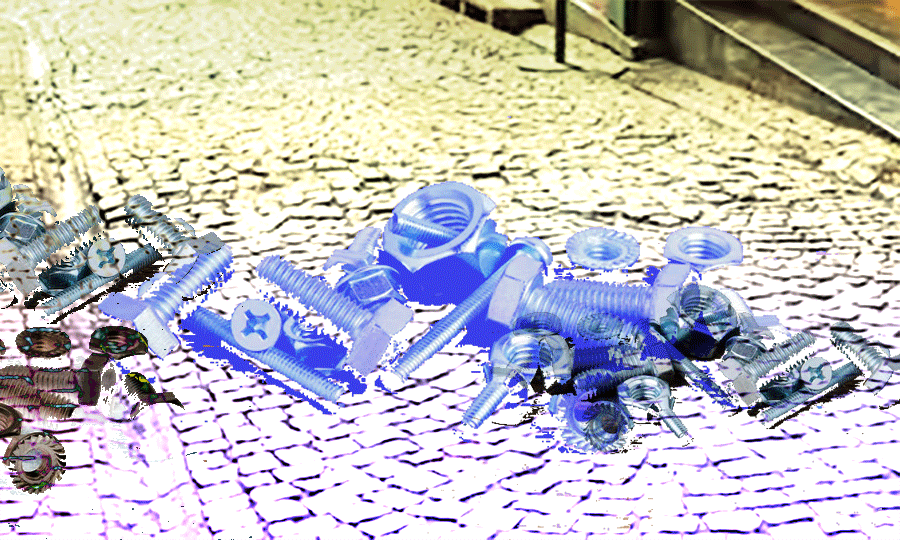
Her body hits the hood with a soft sound. The bag bursts. Bolts roll down the cobblestones, clinking like a shower of needles.
Finally, silence.
The soldiers are shouting. But it’s a military scream. A cry of ordered panic. Already, we’re trying to suffocate. We close up again. An officer is arriving. The orders fall. We take Edward away. We barely warn the widow. We classify.
But what no one sees is the exact moment when the rift opens. It’s not death. Nor fear. It’s refusal to see.
An injustice too clear, too immediate, too ignored.
At this moment
At that precise moment, in the corner of the bridge and the showcase, a membrane tore. Time moved backward by one step. And the place remained frozen, like an eyelid left ajar. Since, every evening anniversary of November, at 19:23, the layers overlap. The air is shaking slightly. The dogs are agitated. Some children cry for no reason. And those who have mixed blood in them that evening—like Jules-Marie — perceive the dull throbbing of the rift. For a rift is not a wound. It’s an expectation. A memory that doesn’t want to die.
A breaking point so clear that it becomes sacred, not by greatness, but by necessity. And as long as an heir—by blood or shame — has not made it to the end, the flaw will remain there. Half visible, half alive.
Like an old nail that we can’t extract from the wood. Jules-Marie had believed that it would cross. That the crack was just a border. That beyond there would be a heart. A truth. An end.
But the rift, he learned little by little, had no center. It was all centers at once.
One evening, he pushed a door into a faded alley. It did not exist the day before. It was a simple frame of black wood, without a handle, without a threshold. But behind it, there wasn’t a piece. There was something else.
On Bended Knee
And the world rocked. It was not a journey. Nor a dream. It was a dislocation.
He saw the hardware—but without Gabriel. Then the hardware — with two Gabriels. Then the ironmongery — held by Edward Lancing, alive, happy, speaking French, married to the widow Menestrel. Then a city without a bridge. Then a city submerged. Then a German city. Then a city where he himself — Jules-Marie—had never been born.
The scenes passed by, slow, impassive. Like slides without a projector. He fell to his knees. The rift was not an accident. She was a knot, a point where all the versions of the world rubbed together without ever getting confused.
He heard a voice. His own. Coming from elsewhere.
— You cannot pass. Because there is nothing to reach. There are only combinations. The thousand forms of what could have been. And none wins.
He stood up. Or thought of getting up. In front of him, there was a child. Maybe him. Maybe his son. Or a child never born, fruit of a world where the rift had never opened.
The child reached out his hand.
— You are not the one who will cross. You are the one who sees.
So
So Jules-Marie understood. The rift was not a place, but a function, a tension, a tear in continuity, caused by the initial injustice—this injustice that has never been confronted.
He stepped back. Slowly. Went out the door. The world returned. The rain. The cars. The shadows. The loneliness. But he knew. He wouldn’t go through. He would inhabit the rift, would be the witness. The one who looks at all possible worlds and chooses to stay in the one who did not know how to avoid the drama. Because that’s where memory is and remains.
And in that world, every evening at 19:23, on the bridge, the bolts still roll. And a certain evening in November, the rift opens there. Jules-Marie finally lives in the only world he has ever truly known: the one where the bridge killed a man, where the hardware store closed, where the Menestrels were scattered like old melted lead.
He took over an apartment in the old town. Above an empty shop. He works at the local museum. He files the archives. He restores old plans. No one really notices him. But he is there.
There
He does not write. He does not speak of what he knows. He has no message, no mission. He is not a prophet. He is a man who has seen — and who has chosen to stay. He accepts the plot. He inhabits it. The one where mistakes do not fade, where wounds do not always close. Where unwanted threads can learn to walk straight, despite absence. Where the dead have died for good, and the living struggle to understand why.
He even agrees to not fix anything. He feels his anchorage to the real, as if he were saying to the universe: I know that you hold me, that I am one of yours, that I could be elsewhere. But I am here. And I stay.
Maybe in the end, this is what the universe expected of him. A loyalty, to a line of reality among billions, to a bridge where nothing has improved. But where someone, one evening, returned. Jules-Marie no longer needs “to go to the bridge”, the need has faded. Not by forgetting — never—but by integration. The bridge now lives in him. He continues his life in the city—this city that suspects nothing, which has forgotten the Menestrels, the shock, the soldiers, the bolts. He reads. Poems by Musset, among others. He watches the seasons pass on the faded facades. He speaks little. People say he is discreet, composed.
Some, without knowing why, lower their voice in his presence.
At 19:23
But every day, at 19:23, he stops. Wherever he is. In the kitchen. In the street. In the library. It’s not a sudden stop, it’s a tiny slowdown, like a suspended breath. Not a ritual, nor a superstition, but a deep agreement. As if his being, from the rift, vibrated at the exact hour of the shift. A sensitive chord, stretched between the worlds, which resonates softly when this minute passes.
He doesn’t look at the time. He knows it. It’s a presence. The one that will last for certain generations, the astonishment moreover for those descendants who will not understand why they look at their watch so often precisely at that hour. He no longer seeks, no longer wonders why him, why this place, why this life. He knows that it is enough. That carrying the weight of a world—even a twisted, broken, unfinished one — is sometimes more noble than exploring a thousand others. It has remained. And staying, in a world that slides, is a form of courage.
Then at 19:23, he sometimes smiles. For him alone, citing with irony and hindsight “Great men are always alone”.
The flaw is still there.
She is no longer an abyss, but has become the invisible tuning fork of her soul. And when he dies — for he will die like every man — his fulfilled life, he will simply join, out of fidelity, the vibration of 19:23.
Alain Aillet Sayings
- The Hardware Fault
- Shadows Hardware
- Message in a Bitter
- Star Traveler
- The Distorted I
- The Purple Ribbon
- Immortals Café
- Aurochs Ford 2
- Aurochs Ford 1
- Pech Merle
- The Sons of Light
- Eternally
- Planet E
- From Tautavel To Bozouls
- Odious Odin, Frightening Freya
- Teutonic, Archetypal Language
- Planet Babel
- Sounds And Languages
- The Golden Tongue
- Decipher Hieroglyphs