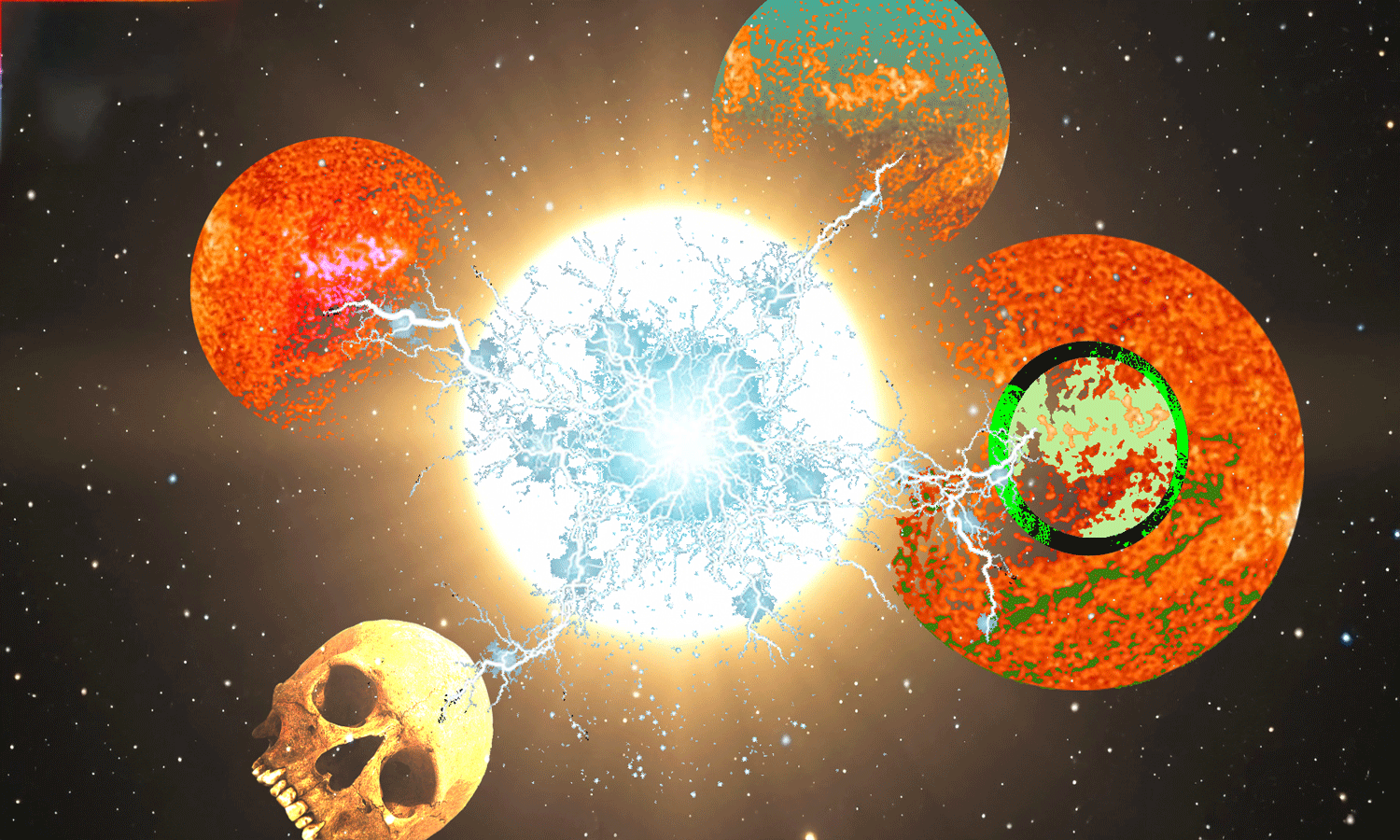
He descended through an ageless night into the womb of dreams. The aurora had not yet stained with pink the curtains of the world that already its heart, powerful foliage turned upside down by the winds, beat against the opaque walls of existence.
The poet in him—wounded beast with the fangs of the absurd — had tired of the spitting of reality: the city chats, the passersby without eyes, the harsh light of the days. So he planted his flags in the ether, he said:
-Since life refuses itself to me, I will build my kingdoms in sleep.
Kingdoms
Every night, he leaned over the black chasm of closed eyelids like an alchemist on his crucible. He threw himself into it naked, without words, without form, begging for the sacred fire. And in this vertigo, something gave way. The dream, until then a crazy rider, bent his knee. He saw the walls dissolve, the faces recompose according to his desires. Time unfolded in a spiral. The laws were his.
He flew. He loved. He knew.
The sky over there had no more anger. It spoke to her in fluid colors and the sea, a sweet lover, offered its singing shells. He repainted the grey faces of the world with inks drawn from his sleep: violent blues, liquid oranges, scented silences.
Eye up
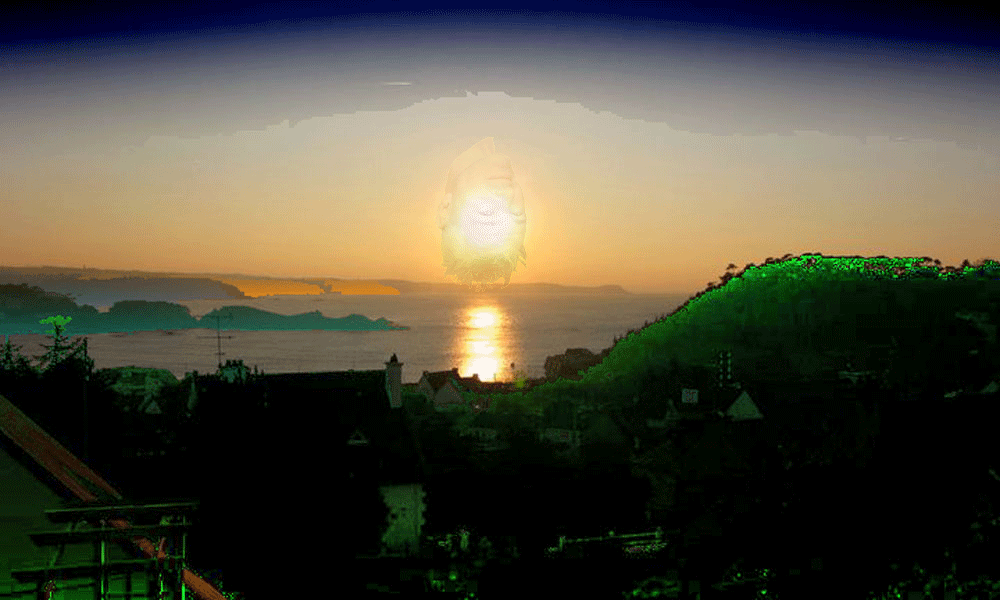
And every morning, as he flashed back from the dream, he opened his eye as one half-opens a door onto a barren garden. The real, still collapsed, covered itself with a more tender veil. He saw in it the rift, but also the light that infiltrated it. The horror had not been extinguished, he had wrapped it in his secret fabrics.
Finished the condemned spectator of the world. He became the invisible craftsman, the sculptor on the other side of the mirror. And even if the day strangled him, the night gave him back infinity.
Time became an eternal line on which he went as he pleased, settling in the moment on the thread of eternity like a migratory bird on a cable of chance, to seek rest there.
Tilted Heart
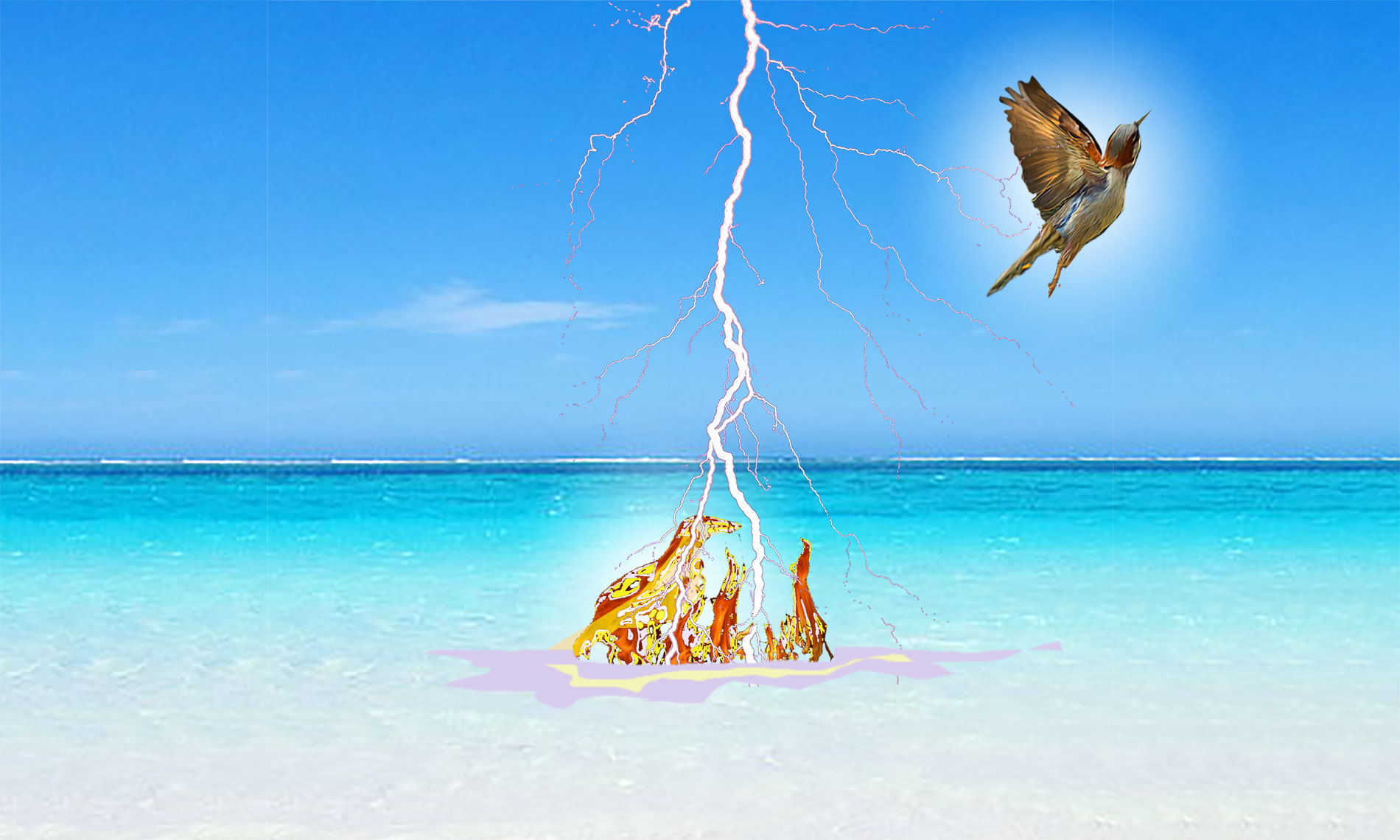
One evening, moreover, he took the shape of a bird. It was not a dream, nor even a flight. It was an ascent. He no longer had neither a name nor a body, but lukewarm wings, hemmed with lightning and oblivion. His heart, now broken, palpitated to the rhythm of the hills. Each beat lifted the world with a lash of light.
Lightning governs everything.
He had torn himself away from the creaking cobblestones, from the cracked figures of ordinary days. From above, the human pains were no more than tremors in the cloudy water. The shouts, the races, the angers—all that seemed like breaths in the dust, lines in the sand that the sea would come to smooth.
He hovered. Not out of pride, but out of clarity. He saw the child who cries in a wet courtyard, the tired woman whose laughter only comes out as memories, the man on his knees under the palpable weight of a future too heavy. Unable to tell them anything, he covered them with his gaze.
Curved Memory
Gaze soaked in the secret sources of the dream. Gaze that was no longer that of a man. Which was no longer judgment but an invisible caress: a burst of azure resting on the temples, a warm sigh that makes the curved necks straighten.
The lower world didn’t realize it. Yet it shivered, light. The tears dried a little faster. The walls vibrated with a forgotten memory. And sometimes, without knowing why, a passerby lifted his head towards the sky, just for a second—as if the echo of a wing had brushed against his soul.
It was him, of course. He was the bird-poet, transfigured by sleep, returned to sow indulgence in the furrows of reality.
He didn’t heal anything, didn’t erase anything.
He placed on everything a hint of tender gold, a bit of a dream that had fallen from my feathers.

Blue Fall
But the dawn is a cruel frontier.
He was still up there, grazing the roofs of the night, when he felt, in his wings, a strange cold. Not the coldness of the wind, but that of time—this slow grin that always returns to claim the absent bodies. The dream, so vast, so true, began to twist at its angles. The air became dense, the colors paled like a stained glass window that was emptying of its fire.
Then he knew that he could not remain a bird. His flight, once drunk, became uncertain. His heart sank. Each beat reminded him that he had a name, a weight, a mouth to feed with words. The world below, this rough old world, called him back.
He fell.
It was not a violent fall, rather a sad slide, like that of a fabric that is carefully folded before putting it away. He returned to his body as one returns to a chamber without fire. He felt his fingers weighted down, his eyes clouded with wakefulness. He returned to the gentle prison of man, this habit too tight for the soul.
Low Tide
The dream did not fade away—it withdrew, slowly, as the tide leaves its shells and secrets on the sand.
The poet bird fled still guarded, under the eyelashes, a bit of the sky. But the world had returned, with its angles, noises, uncompromising truths.
He cried. No sadness, recognition.
For he knew, henceforth, that one cannot always live in the dream—but that the dream can live within us, like a discreet fire, a honey under the tongue, a tiny star at the back of the eye.
And that, he carries it everywhere.
In the street. In the books.
In the eyes of a passerby
that he brushes against like a forgotten wing.
No Fear
Since this gentle fall, he lives between two worlds, like a watchman leaning in the window of the unreal. He walks in the city but he barely touches it. Passersby pass through it like hurried mists. He speaks, he laughs, he also sleeps — but everything in him remains tense towards the invisible Eden that he saw opening under his eyelids.
Eden has never left it.
Sometimes, in the bend of a breath, it comes back to him: a burst of azure between two syllables, a shiver of wind that does not have the taste of earth. Then he closes his eyes, briefly, and he breathes as one drinks an absence.
Eden flows within him.
Nothing Changes
The others don’t understand. It’s not a big deal.
They did not read his inner saga, that long poem he wove with feathers and smoothed with silence.
They do not know that he was a bird. That he flew over the pains and caressed souls without touching them, that he loved the world more than a man can love a woman or a god.
And that he fell — not as punishment, but out of necessity.
It is necessary to return, always, even the wolves return to the den when the snow drips from the skies, to watch over the clan and hold another winter. But in my night, nothing really changes.
Dream
He falls asleep every night with that smile of those who believe without believing, that half-knowing that there is something else behind the curtains, behind the legends, behind all the words in the world. It’s not a lie. It’s loyalty. Under the shadow of a bird that he was. To a fire that still burns him, gently, behind the forehead.
And when the last night comes, the great one, the one from which one does not return—he will ask for neither light nor prayers.
When God wants to punish us, he answers our prayers.
He will ask for wings and the right to dream again. Dream just once all the realities in him like a poem without fear.
Articles by Alain Aillet
-
- The Golden Tongue
- Sounds And Languages
- Planet Babel
- Fairy Laughter
- Teutonic, Archetypal Language
- From Tautavel To Bozouls
- Planet E
- Decipher Hieroglyphs
- The Sons of Light
- Pech Merle
- Eternally
- Aurochs Ford 1
- Aurochs Ford 2
- Immortals Café
- The Purple Ribbon
- Star Traveller
- The Distorted I
- Erquy-librist’s Travel
Reki-librist Vertigo
Yes, I am this dreamer that you described well. In the Land of the Last Summer, the Indians have named me Reality Dreamer. This name suits me, I wouldn’t change it. It describes me without saying anything about who I really am. As you did too. Take a piece for the whole: a smoky delirium that serves as our Dream.
But the Dream is bigger. It flies and overwhelms me. It rejects me from afar…
Reki Libre
Erquy, yes, one can say. That’s the name. Yet I went to get the original, the one given to him by the Greek settlers many moons ago. Reki. Two centuries later, or two thousand years, what do I know? Caesar came to annex Gaul. Not all of Gaul. A small village is still resisting the invader.
It’s here, it’s mine. Reki that the Greeks rebuilt once, and still rebuild, because of the Viking giants who so often sacked it. Each time, the Greeks rested the stones on the stones. They named this new village Reki Nea, the new Reki.
Now the people here have forgotten it. They only remember the Roman village, the one that Caesar eventually conquered. He kept the Greek name that sounded good in his ear. But today’s people do not know at all why they are called Regineans. They don’t know that the Latin g was a hard g, which is pronounced like the k of the Greeks.
The city was Rekinéa, its current inhabitants are Regineans. No mystery for the passionate historian that I am. And there I practice a reki that goes back many years before the one a Japanese thought he would find. He unknowingly drank from the Greek source with long strokes. And the Celtic section too. And the Viking crater.
Moons’ Dreamer
Worlds’ Dreamer, I don’t spend my nights there. I spend my life there. Early morning, I dream. At noon, the dream too. On the road, it continues: I drive with one hand and with the other I dream.
So far, it’s worked out for me. Don’t take the Moons’ Dreamer for a sleeping one who has lost all contact with the affairs of here below. On the contrary, I am a Dreamer of Realities. I know before the stars the weather that it will be next year at this time.
My friend Alain gave me the pleasure — and the scratch — to disguise myself in an uchrony that says a lot about his wandering.
He has the same as everyone else. How would I hold it against him? Few people understand the awakened. Which is not surprising: the awakened no longer know who they are. Nor what they have been. And who they have stubborn. I dream that I remain silent for hours, eyes in the wave, heart in the full sun — even at night.
2085
A daily meal is enough for me, I have a belly to lose. I feed myself every day with the same dish, Kashmiri Massala. A delight forgotten for 40 years. Pleasure to be able to get the spice of the same name again. At Patak’s. Avoid Raja. Free advice, no promo, be sure!
See how I insert myself into the lively flesh of the world. Free or not, the human remains in prison. If he feels free, he understood Cesbron: our prison is a kingdom.
My darling has her life ahead of her, not me. Besides, who knows? She can die tomorrow, in an hour, just now, and we will die together. But I would last a few minutes longer. Or more! I might last until 136 years.
In 2085. It’s the time when I would like to leave. Until then, my darling will be close to me — even within me whenever she wants. Or both if she wants. Whenever she wants.
To Be Honest
The truth? Do you want to know the truth? I am a fucking bitcher. Downright mean, never happy. I grumble all the time, I moan, I mumble, I growl and I criticize at every turn. I have a heart of gold, that’s right, but I keep it well hidden for fear of being snuffed out. People are so mean! I hate this false world where they force me to live.
As soon as I can, I escape to the perfumed elsewhere, virgin lands, eternal pastures of hyper-space, infinite meadows of infinitely pure, parties that last a century or two seconds, an hour, a millennium, and close your camembert box you will open it for dessert.
Long live life out of time, the space gathered all at one point, the same fist that goes into your mouth, you failed asshole who pretends to exist, squirting away, your toes tapping on a virtual keyboard, your head yawn and you spit, you glave as much as a leaky faucet, stubborn party animal, asshole casserole, shut up your peak beak, dodo kitten in the garden.
I’m fed up.
To be honest, down here, everything is fake. My damn character is part of the lot.
 This series brings together texts co-written by Alain Aillet and Xavier Séguin. It is called World AAXE.
Neo Reki
- The True Story Of Reiki
- The Body Knowledge
- Energy blockages
- These Hands of Love
- Kundalini Reki
- The Neo Reki of Rekinea
- Erquy Reki
- Celtic Reki
- The Nagual Reki
- Fifteen Chakras
- Twenty-three Chakras
- Subtle Sensors