


… Which could equally well be called the Discourse on the invention of morality. Nietzsche details how Good and Evil replaced Pleasure and Pain. A major societal shift. The being, the only judge of his life and his behavior, sought epicurean pleasure. With the advent of Good and Evil, the individual replaces being. And the social group passes judgment on him.
The Prejudices of Philosophers
To follow the dictates of morality is to submit oneself to priests, judges and professors. The elite imposes on the masses an obligation disconnected from organic life and the way of nature. And this obligation applies to all areas of social or individual life. Yet, only the masses are constrained there, the nobility and the clergy feel as always above these constraints which they judge to be foolish.
If they are useless, why impose them? Because they are silly, these rules only apply to fools. You and I, dear friends. You have to find a reason, the powerful are and will always be untouchable. For Nietzsche, the only powerful ones who matter are metaphysicians. His peers, if not his peers.
My peers? he exclaims horrified. Come on, you will have misread me. I have nothing, no, nothing at all like a dog’s son. Tchaaaa! Damned cold! … Nothing like a metaphysician, at least nothing about those people who mock and rise up all the way through the living rooms. Can a true philosopher be worldly?
“Being admitted that we want the true, why not rather the non-true? And uncertainty? Or even ignorance? The problem of the value of truth has arisen before us, — or is it we who have encountered it along our path? Which of us is Oedipus here? Who is the sphinx? It is there, it seems, a knot of questions and question marks.” (source)Friedrich Nietzsche, Beyond good and evil, The prejudices of philosophers, NRF Gallimard, page 21
After Physics
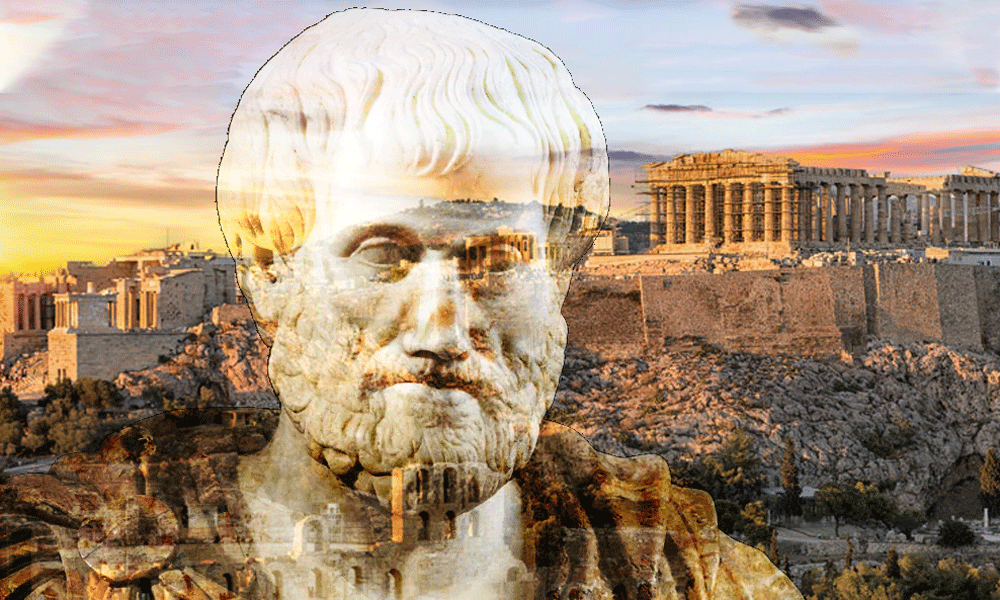
Ta méta ta fuzika, title the book by Aristotle which, in his work, comes after Fuzika, Physics. Aristote did not know what name to give to the ‘more than science’ he was discovering. A science more eternal according to him than geography, more interior of the pysique too…
What comes after physics, non-title par excellence, has definitively titled the queen discipline of philosophy, metaphysics.
The antinomy of values
“The fundamental belief of metaphysicians is the belief in the antinomy of values. Even the most cautious, those who had sworn to ‘omnibus dubitandum’, to doubt everything did not take it upon themselves to cast doubt on this point, at the very threshold of their company, when doubt was most necessary. loc. cit., page 22
Of course, this belief in couples of opposites is a dirty habit of too simple people. True philosophers should have made fun of it, Nietzsche is right to do so, and to insist on it. Thus he gives a few lines further this example crying: “Consciousness never decisively opposes instinct, — for the most part, the conscious thought of a philosopher is secretly guided by instincts that forcibly lead it along determined paths.” (source) loc. cit., page 23
We can clearly see where the great thinker is going with this. He enters by breaking into the temple of supreme thought to break down its statues, reduce dogmas to mush, highlight inconsistencies and denounce naivety. One understands how much he may have been hated during his lifetime, him whom nothing can stop, him who respects no taboo.
Come in, Child
What does this widespread demolition company lead him to? Being at this point systematic, isn’t Nietzsche likely to make it his system, neither better nor worse than those he denounces? Which of us is Oedipus here? Who is the sphinx? It is there, it seems, a knot of questions and question marks.” (source) loc. cit, page 21
He keeps attacking the antagonistic tandems, quite stupid, but he allows himself to refuse everything, to send back and forth like each other, with adolescent violence. Being admitted that we want the true, why not rather the non-true? And uncertainty? Or even ignorance?” (source) loc. cit, page 21
Is Nietzsche too vehement to rediscover the spirit of childhood, the true wisdom and the joy that comes from it?
– Come in, child Friedrich. You will find to welcome millions of young earthlings who, like you, have only the ‘no’ in their mouth and heart. But there are many more who marvel with the sun in their eyes…
Aux Feuillantines
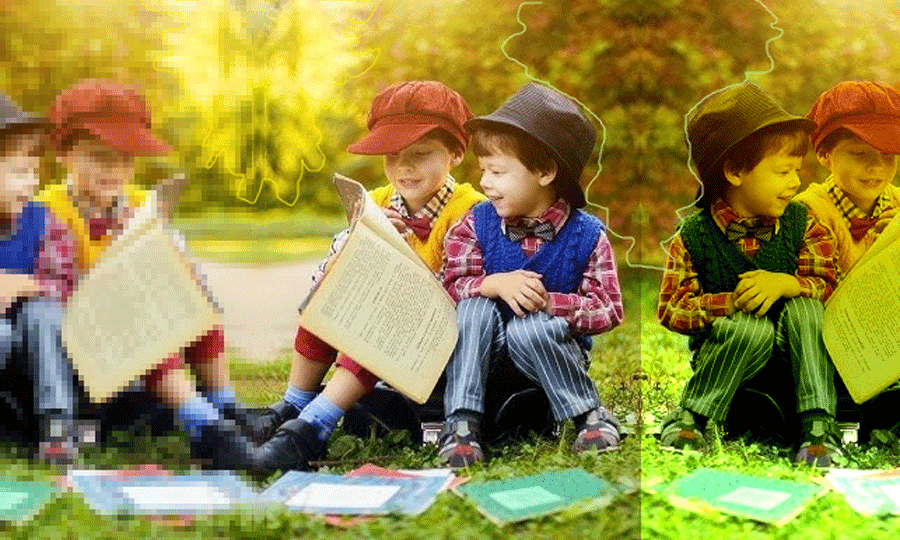
My two brothers and I, we were all children.
Our mother said: play, but I defend
That we walk in the flowers and climb to the ladders.
Abel was the eldest, I was the smallest.
We ate our bread so well,
That the women laughed when we passed by them.
We were going up to play in the attic of the convent.
And there, while playing, we often watched
On the top of a cupboard an inaccessible book.
We climbed one day to this black book;
I don’t know how we manage to get it,
But I remember well that it was a Bible.
This old book smelled like a censer.
We went delighted in a corner to sit down.
Prints everywhere! what happiness! what madness!
We then opened it all wide on our lap,
And from the first word he seemed so sweet to us
That forgetting to play, we started reading.
We were all three like that, all morning,
Joseph, Ruth and Boaz, the good Samaritan,
And, always more charmed, in the evening we read it again.
Like children, if they have taken a bird from the skies,
Call each other while laughing and are surprised, joyful,
To feel in their hand the softness of his feathers.
Victor Hugo, The Contemplations
Persist and Sign
“The question is to what extent a judgment is capable of promoting life, preserving it, conserving the species, even improving it, and we are inclined to posit that the most false judgments (and among them synthetic judgments a priori) are the most indispensable to our species, that man could not live without rallying to the fictions of logic, without relating reality to the purely imaginary world of the absolute and the identical, without continuously distorting the world by introducing the number into it.” (source) loc. cit, page 24
The Synthetic A Priori Judgment
Emmanuel Kant is the inventor of this concept of judgment which is characterized by the combination of two apparently opposite characters: they are synthetic, that is to say (in the term of Kant) increase knowledge, and yet are a priori, that is to say, anterior to experience. (wikipedia)
Kant was a man of habit, every day of his life he made the same journey from his home to the school where he was a student then a teacher. No doubt this total absence of diversity mattered to him, as he considered himself inhabited by pure reason alone.
Poet and Philosopher
Arriving after the philosophers of pure reason, notably Kant or Hegel, Nietzsche is necessarily opposed to this mental aberration that is synthetic a priori judgment. But like the crow of the fable, he opens a wide beak, lets down his prey. Wanting to kill Descartes and his followers, Nietzsche enhances his coat of arms. To exterminate castrating logic, can it really fight it… with logic??
“The question is to what extent a judgment is capable of promoting life, preserving it, preserving the species, even improving it.” (source) loc. cit, page 24
Question that strongly resembles a priori synthetic judgment. He justifies himself by adding further: “In a philosopher, nothing is impersonal, and above all his morality rigorously testifies to what he is, for it reveals the deepest instincts of his nature and the hierarchy to which they obey.” (source) loc. cit, page 26
That, it seems to me, defines the poet better than the metaphysician. It is true that Nietzsche holds both characters, that’s all that makes his charm besides. In this eminently Nietzschean allegation, I also recognize the seer, the shaman, the fairy, all those who dedicate themselves to embellishing this world by never using logic.
Nature? What Nature?
“Do you want to live ‘in accordance with nature’? O noble stoics, how you pay each other with words! Imagine a being like nature, prodigal without measure, indifferent without measure, without purpose or consideration, without mercy or justice, fertile, sterile and uncertain at the same time, conceive of indifference in itself as a power, how could you live in accordance with this indifference? Isn’t living precisely the desire for something other than this nature? Doesn’t life consist of judging, preferring, being unfair, limited, wanting to be different? And assuming that your maxim ‘living in harmony with nature’ means basically ‘living in harmony with life’, how could it be otherwise?
How right! Nature knows how to do nothing on its own, because being everything, it is nothing. It is an abstraction devoid of reality, sometimes drought, sometimes flood, sometimes tornado, sometimes tidal wave, sometimes fertile, sometimes arid, sometimes gentle, sometimes brutal, sometimes hostile, sometimes welcoming. It has no cause or effect that belong to it, because it does not have its own existence. Nature is not even a concept, it is just a simple word that includes everything that lives, grows and dies.
Planets Arranged
We call a developed planet a wild planet made habitable. Any planet that is managed is taken care of in the long term by a line of Terraformers. Earth is one of them. It is very far from being the only one. All the wild planets are convertible. Those that are located at the right distance from their star and have an atmosphere are arranged first.
Developing a wild planet is a big contract, which will mobilize millions of gods and angels for billions of years. Good wild planets are becoming rare. Developers compete for them. There are very few that remain available. Everywhere in the universe, the hunt for big contracts rages on. All the planets of the galactic center were arranged in the mists of time.
For two billion years, which is quite recent on the divine scale, planners have been tracking much more distant star systems, if not outright eccentric, like our tiny solar system. They have even expanded the eligibility criteria. They feel worthy to build the worst trash planet. With its oceans invaded by plastic and baby layers. It wouldn’t be bad if they came back to give us a shot to clean the Earth that meets their criteria.
When they land on a virgin planet, they come to win. No matter that the atmosphere is not breathable, Terraformers can change it. No matter how many volcanoes there are, the Terraformers will fix it. It doesn’t matter that the marshes invade almost all of the plains. Or that unfathomable faults shear the planetary crust. Or that the temperature shows too large differences. Or that the mountains are too high. Or that the surface is devoid of oceans. Whatever the damn problem, be quiet. Terraformers will put it in order. That’s their job. (read more)
Where do you see nature, in there? One last time let’s say, nature is only seen from the mind.

Friedrich Nietzsche
- Prophet Nietzsche
- Anarchist Nietzsche
- Superhuman Nietzsche
- The Will To Power
- Dance in chains
- Beyond Good and Bad
European Thinking
- Oronce Finé
- Meister Eckhart
- Rene Descartes
- The Continuing Creation
- Volontary Servitude
- Baruch Spinoza
- Free Will
- Courtly Love
- Pascal’s Wager
- Immanuel Kant
- Kant and Pure Reason
- Hegel And Nothingness
- Divine Mathematics
- Magical Thinking And Daily Magic
- Karl Marx and God
- Karl Marx and his Double
- Matrix And Memory
- Reflection And Action
- Prophet Nietzsche
- Anarchist Nietzsche
- Superhuman Nietzsche
- The Will To Power
- Dance in chains
- Beyond Good and Bad
- Henri Bergson: Time And Duration
- Vitalism of Bergson
- Miguel de Unamuno
- Pleasure and Freud
- Jung vs Freud
- Albert Slosman
- Marguerite Yourcenar
- High Time
- Progress, Suicide Or 5G?
- Truely Wittgenstein
- The Lying History
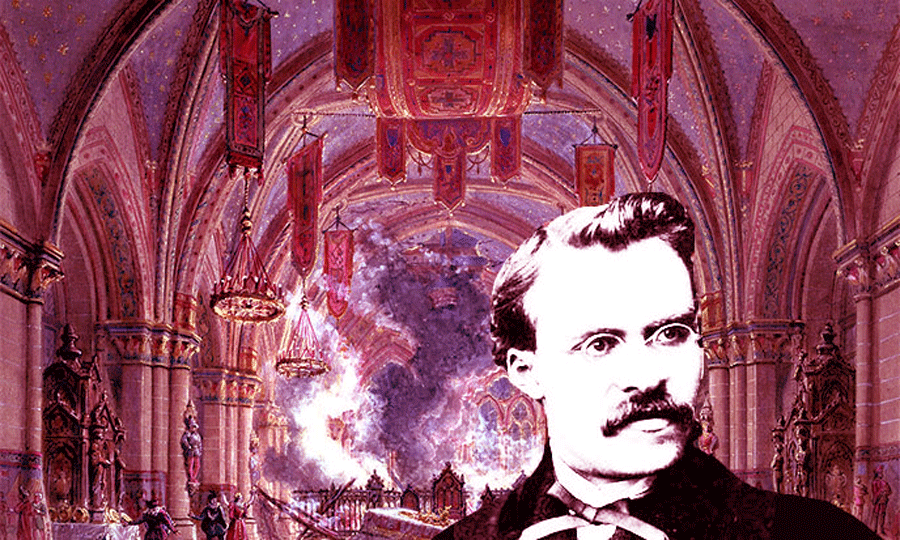
“Philosophy is this tyrannical instinct itself, the will to power in its most spiritual form, the ambition to create the world, to institute the first cause.” ~~ Friedrich Nietzsche