


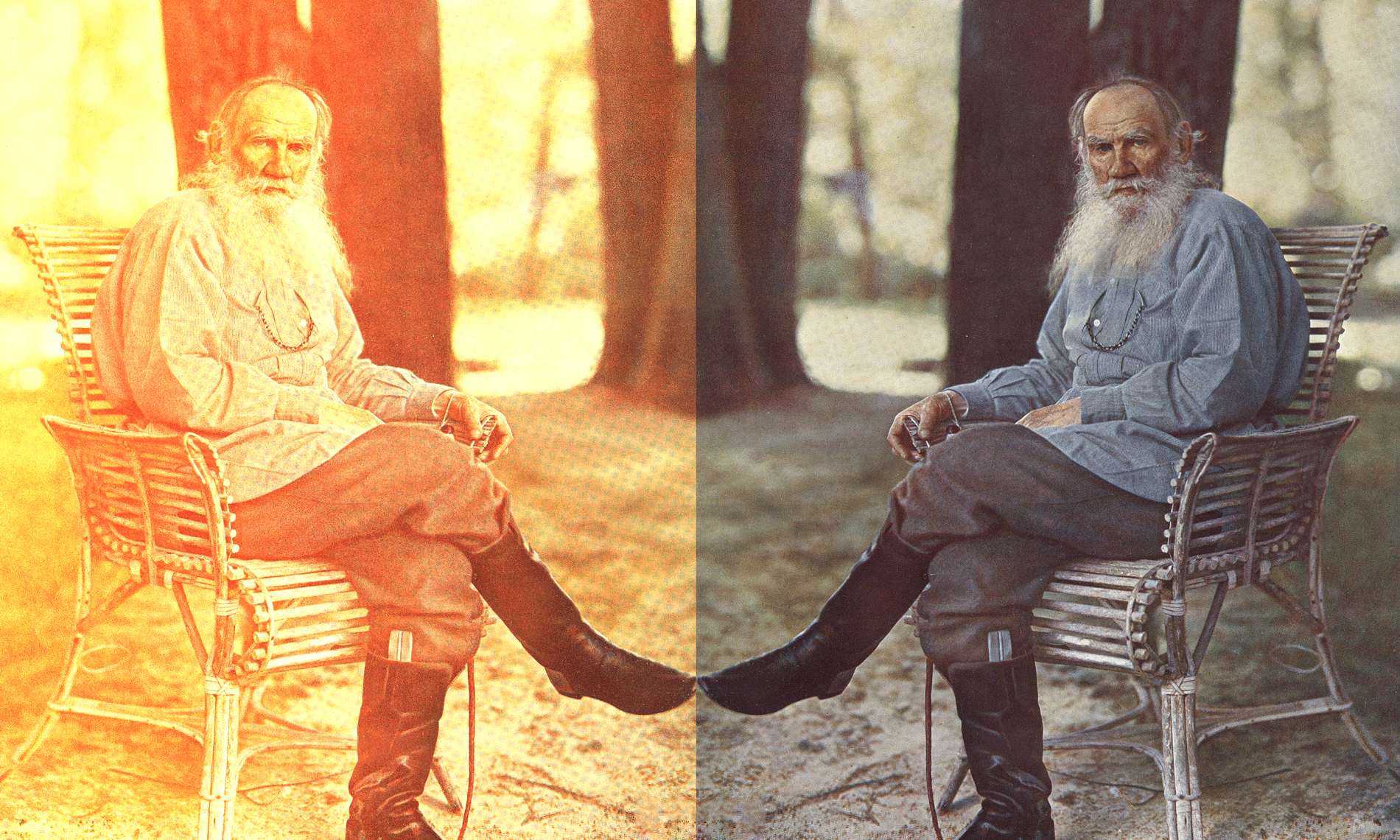
“I’ve been through a lot and I think I’ve found what happiness requires. A quiet life in the countryside with the possibility of being useful to people, doing good to them, who are not used to being done by them. A work that one hopes to be of some use, and rest, nature, books, music, the love of others. This is my idea of happiness.” (L. Tolstoy, Happiness in Family)
 Sad Sad Tolstoy
It is true that Tolstoy work as a novel does not exude the joy of living. Born in 1828 in Isnaya Polyana, in the province of Tula, Leo Tolstoy divided his life between the operation of his family estate, numerous trips to Europe and literature.
He is proud, full of hope while waiting for glory. What is empty and vain. As a result, he does not love himself. He has never loved himself. “I am ugly, clumsy, unclean, and without the glaze of society. I am irritable, unpleasant to others, pretentious, intolerant, and shy like a child. I am ignorant. What I know, I have learned here and there, without any follow-up, and still so little! But there is one thing I love more than good: it is glory. I am so ambitious that if I had to choose between glory and virtue, I believe I would choose the former.” (Diary, July 7, 1854)
War and Peace, published in 1867, was a huge success, confirmed by the publication of Anna Karenina (1875-1877). Leo Tolstoy, the greatest novelist of Russia and perhaps of the world according to Turgenev, has reached, with War and Peace and Anna Karenina, the summit of the novel art. (source)
In the last years of his life, he finds refuge in his Christian faith and in social works. “I have experienced many things and I believe I have found what happiness requires” écrit-il. Mais il ne l’a jamais vécu. Leo Tolstoy died in 1910.
Lev Nikolayevich
A force of nature, an “untiring brute”, so he describes himself. This titan to whom life has given everything, genius, glory, love, health, remains constantly haunted by the idea of death.
 Already as a child, he experiences unreasoned fears: “A frozen terror takes hold of me and I bury my head under the blankets.” All his life, he rubs despair, to the point that he must remove a rope from his room, for fear of hanging himself.
Sometimes fiery, sometimes downcast, divided between his appetite for happiness, which inflates his creation, and a ruthless lucidity, he denounces the illusion of happiness.
Leon Tolstoy will try to exorcise his torments by engaging in marriage, in literary creation, in social activities: a derisory game intended to deceive the omnipresent anguish of death. (source)
How to reconcile his anguish of death with this unquenchable thirst for glory and recognition? The contradictory task was impossible. He failed.
What Happiness?
No, Tolstoy’s work does not breathe joy or good humor. Was he even happy? I sincerely doubt it.
Misfortune can be seen on his face: distrust, rejection of the world, Tolstoy is elsewhere. Where he suffers less.
 From his disjointed youth to mysticism and old age, through his family life in the property of Iasnaya Poliana, Tolstoy had a romantic life worthy of the characters who populate his novels.
Tolstoy’s thought is marked by an uncompromising Christian mysticism. Already famous in his lifetime, the novelist has thus engaged in numerous controversies on this subject with the intellectuals of his time. (source)
Through the intellect, he explores feelings and passions that he recounts instead of living them. Instead of being in the world, he will live a thousand deaths.
But the real one won’t miss it… The Reaper doesn’t spare one life, no matter how sad it was.
Leo Tolstoy and Fyodor Dostoevsky are known for having written, in their monumental works, characters with contrasting personalities.
In the end, this “novelist of infinity and totality” won neither.
Until the End
And he finally concluded. Here is his final regret. His last wish to achieve happiness.
“And then, to top it all off, you for a companion and perhaps some children. What more can a man’s heart desire?”
To be happy, truly happy and at peace. This is what a simple heart can desire. And this simplicity, Léon never had it. Rough or superficial, adventurer of the slipper under the table of nirvana, Léo Ferré danced from one foot to the other in front of the buffet of life. Did he even live? I doubt it. He rowed, the devil. At the very end, he won his last battle, to defeat himself. He was wrong until the end.
Happiness cannot be conquered. It falls on us when we are ready to welcome it and honor it as he deserves.
European Thinking
- Meister Eckhart
- Oronce Finé
- Rene Descartes
- The Continuing Creation
- Volontary Servitude
- Baruch Spinoza
- Free Will
- Pascal’s Wager
- Courtly Love
- Immanuel Kant
- Kant and Pure Reason
- Hegel And Nothingness
- Divine Mathematics
- Magical Thinking And Daily Magic
- Prophet Nietzsche
- Anarchist Nietzsche
- Matrix And Memory
- Superhuman Nietzsche
- The Will To Power
- Dance in chains
- Beyond Good and Bad
- Karl Marx and God
- Karl Marx and his Double
- Reflection And Action
- Tolstoy and Happiness
- Henri Bergson: Time And Duration
- Vitalism of Bergson
- Miguel de Unamuno
- Pleasure and Freud
- Jung vs Freud
- Albert Slosman
- Marguerite Yourcenar
- High Time
- Progress, Suicide Or 5G?
- Truely Wittgenstein