


 c
c
Always be drunk. That’s it! The great imperative! In order not to feel Time’s horrid fardel bruise your shoulders, grinding you into the earth, Get drunk and stay that way. On what? On wine, poetry, virtue, whatever. But get drunk.
Get Drunk
Beau de l’air qu’il respire
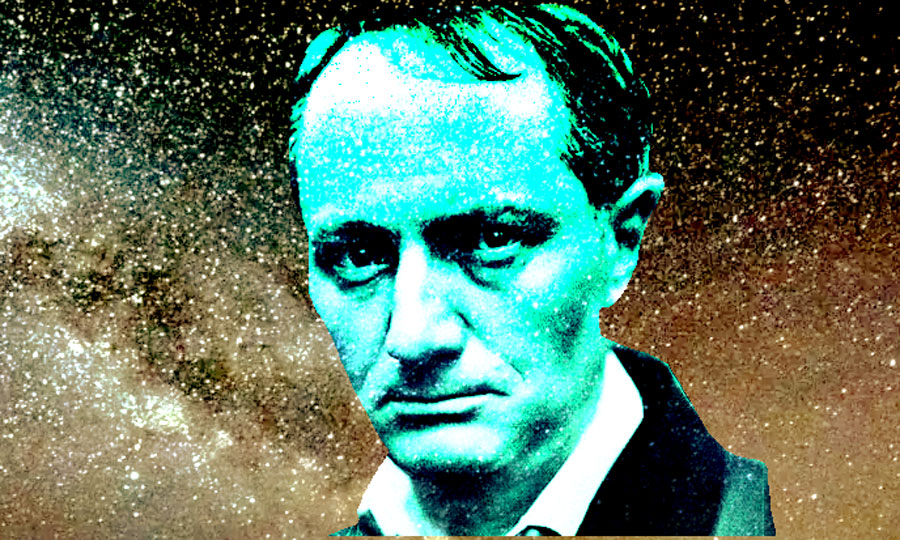
Beautiful of the air he breathes and that he sends back to us with his emotion, Charles B was born, he lived, he died. All this was well put together between 1821 and 1867. Is it worth being born to leave at 46? To be born causing suffering, to live causing oneself suffering, to leave full of undigested pain, such was Charles B, an icon of suffering.
Baudelaire was born on 9 April 1821 in Paris. His father, François Baudelaire, a priest defrocked during the Revolution, a former tutor, retired from the Senate, is sixty-two years old; Caroline Dufaÿs, her mother, is twenty-eight. When his father disappeared in 1827, Charles was only 6 years old and his mother 34. She remarried to a future general. Charles very quickly hated this symbol of the bourgeois order.
At 25 years old, he became an art critic with the Salon of 1845 and the Salon of 1846. He also published poems in magazines and a short story, La Fanfarlo. Then he became the official translator of Edgar Poe (1809-1849).
Quarante-huitardForty-eighter
A brilliant forty-eighter during the 1848 revolution, Baudelaire urged the rebels to shoot his father-in-law, the general.
Cursed Poet
In 1857, Charles Baudelaire published Les Fleurs du Mal. The collection was deemed immoral and, after a trial, the author and his publishers were sentenced to fines and the suppression of six poems.
His literary career is launched.
A key figure in French literature, Charles Baudelaire spent almost his entire life in Paris, which was a source of inspiration and the scene of his escapades.
The poet had during his short life, no less than forty homes in the capital.
From the Latin Quarter where he was born and where he spent the first twenty years of his life to the cafés of the Grands Boulevards, passing through the alleys of the Île Saint-Louis, the poet has never stopped strolling through the streets of Paris.
In this century of urbanization, Baudelaire has experienced three faces of a changing Paris: the old Paris, the era of transformation and finally, the Paris of Haussmann.
City full of contrasts, from great misery to luxurious refinement, it participated by its violence and beauty in the inspiration of the cursed poet. (read more)
The Vampire
Have entered my complaining heart,
You that, stronger than a host
Of demons, came, wild yet prepared;
Within my mind’s humility
You made your bed and your domain;
– Infamous one who’s bound to me
Like any felon by his chain,
Like a gambler by his games,
Like the bottle and the sot,
Like the worms in one’s remains,
– Damm you! Damnation be your lot!
I’ve begged the merciful, swift sword
To overcome my liberty –
To poison I have said the word:
Save me from poltroonery.
Alas the sword! Alas the poison!
Contemptuous, they spoke to m:
“You never can deserve remission
Of your accursed slavery,
“Imbecile! – If our deadly empire
Freed you from your present fate,
Your kiss would soon resuscitate
The cold cadaver of your vampire!”
Invitation to a Voyage
Child, Sister, think how sweet
to go out there and live together!
To love at leisure, love and die
in that land that resembles you!
share mysterious charms
with your treacherous eyes
as they shine through tears.
There, there’s only order, beauty:
abundant, calm, voluptuous.
Gleaming furniture, polished by years passing,
would ornament our bedroom; rarest flowers,
their odors vaguely mixed with amber;
rich ceilings; deep mirrors;
an Oriental splendor
—everything there would address our souls,
privately, in their sweet native tongue.
There, there’s only order, beauty:
abundant, calm, voluptuous.
See on these canals those sleeping boats
whose mood is vagabond;
it’s to satisfy your least desire
that they come from the world’s end.
—Setting suns reclothe fields,
the canals, the whole town,
in hyacinth and gold;
the world falling asleep in a warm light.
There, there’s only order, beauty:
abundant, calm, voluptuous.
Translated by Keith Waldrop“Invitation to a Voyage,” The Flowers of Evil, © 2006
Man and the Sea
The sea is your mirror; you contemplate your soul
In the infinite unrolling of its billows;
Your mind is an abyss that is no less bitter.
You like to plunge into the bosom of your image;
You embrace it with eyes and arms, and your heart
Is distracted at times from its own clamoring
By the sound of this plaint, wild and untamable.
Both of you are gloomy and reticent:
Man, no one has sounded the depths of your being;
O Sea, no person knows your most hidden riches,
So zealously do you keep your secrets!
Yet for countless ages you have fought each other
Without pity, without remorse,
So fiercely do you love carnage and death,
O eternal fighters, implacable brothers!
Sixty years later
I discovered Baudelaire at 15, he immediately became my favorite poet, dethroning Arthur Rimbaud who had killed Pierre de Ronsard. Sixty years later, I loved so many poets: Louis Aragon, Paul Valéry, Verlaine, Léo Ferré… the list is endless.
But more than any other, Baudelaire always takes my heart. The prince of poets. He is sad, that’s true. Me too, I think. He is bitter, often. I fear him too. The comparison ends here.
European Thinking
- Meister Eckhart
- Oronce Finé
- Rene Descartes
- The Continuing Creation
- Volontary Servitude
- Baruch Spinoza
- Free Will
- Pascal’s Wager
- Courtly Love
- Immanuel Kant
- Kant and Pure Reason
- Hegel And Nothingness
- Divine Mathematics
- Magical Thinking And Daily Magic
- Prophet Nietzsche
- Anarchist Nietzsche
- Matrix And Memory
- Superhuman Nietzsche
- The Will To Power
- Dance in chains
- Beyond Good and Bad
- Karl Marx and God
- Karl Marx and his Double
- Reflection And Action
- Henri Bergson: Time And Duration
- Vitalism of Bergson
- Miguel de Unamuno
- Pleasure and Freud
- Jung vs Freud
- Albert Slosman
- Marguerite Yourcenar
- High Time
- Progress, Suicide Or 5G?
- Truely Wittgenstein