


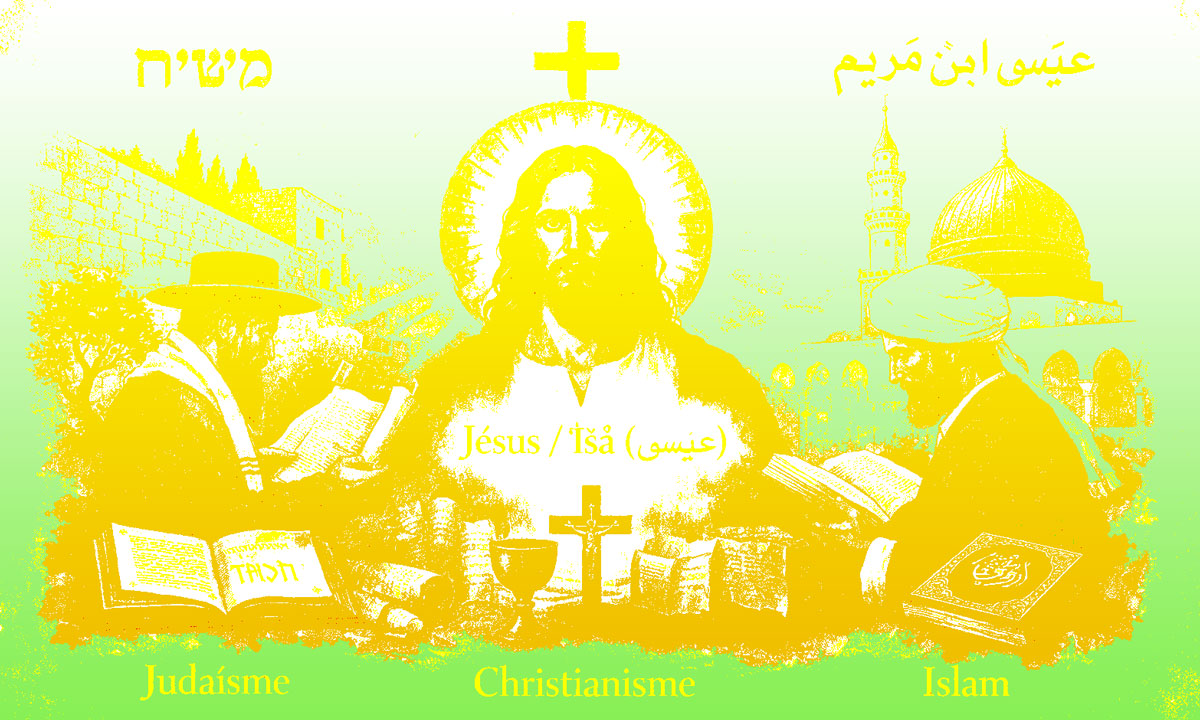
There are many gods. Hundreds. Thousands. Would I say millions? They are very numerous to live around us, they who once lived among us, giants who were careful not to crush us. And they disappeared.
Problem
Since the gods are invisible, maggots have invented the one god.
But each coterie wanted its own god. So, we have lots of unique gods.
Yes, lots of them. All more unique than the others. In the image above, we see the three main ones, but there are others. The gods are so numerous that we can still invent quite a few religions of the one god. A simple directory on the web will allow each new Unique to find its little humans.
New With Old
Who are you, Jesus? A pure and simple invention? It’s hard to get that far. It could be a minor phenomenon that has gone up in spades. His detractors see in him a prophet whose importance has been exaggerated. The cabalistic texts call him the Prince of Matter, a nickname also given to Lucifer — which is another name for the demon. But a demon who brings light, since that is the meaning of the Latin name Lux fero, I bring light. I’m a living lamppost.
Apart from the New Testament and the non-canonical gospels found in the Dead Sea and Nag Hammadi manuscripts, there is no text that speaks of Jesus. So his followers embroidered. They have picked up anecdotes here and there belonging to other prophets, other christs, other gods, assuming that one would see only fire. (source)
The little Jesus and his childhood were borrowed for a large part from Krishna and Hinduism. The teachings that the child Jesus gives to the Sanhedrinunion of Jewish priests are not based on anything palpable.
Aesus Christus is the real model from which this golden legend, too beautiful to be true, was forged. The earlier Christian model was called Sol Invictus. Its Christ was Mithra. This Unvanquished Sun is none other than the mothership Hyperborea, the Solar Arch of the former gods, terraformers of this planet. That’s what I believe — without believing it, as if for sure.
 Shiva + Brahma + Mithra, stacking of unique ones
Through the opaque screen of inventions, erasures, additions and substitutions, it is essential to differentiate between the two Christianisms, the Celtic and the Roman. They are like the two biblical testaments: there is the old and the new. Proto-Christianity and neo-Christianism.
Religion of Light
If the New Testament constitutes the basis of Jesus’ neo-Christianism, the Old Testament is not that of proto-Christianity. That would be too simple. We must add to it the Ramayana, the Celtic Barddas, the Bardo Thodol, the Vedas, and quite a few other sacred mythologies.
You can find everything in the Old Testament. Including horrors. It is the mythological account of our distant past, as also recounted by the Assyrian tablets and the very precious archives of Sumer and Mesopotamia.
These cuneiform Coptic writing tablets contain pell-mell the laws of Assyria, treatises on science and mathematics, and some of the events that once marked this part of the world. Formerly, that is to say a very long time ago.
Anton Parks used it in The Chronicles of the Girku to tell his fictionalized version of the gods of Sumer. I myself have recourse to it when it comes to verifying a protohistorical fact of which I was the astral witness.
As valuable as they are, these tablets do not give us enough information about the old religion. When they were engraved by the scribe’s pen*, this religion was still in force; it was even the only one known. The Assyrian laws are one of its reflections. Yet they are of no help for our subject, the two Christianisms. It’s impossible to count on them to share truth with fiction.
*The scribe’s pen or reed pen is a point-shaped reed that was used for dry writing on clay tablets. It gave its characteristic shape to the cuneiform script: small triangles, fruits of the sinking of the calame into the soft clay. (source)

Children of Isis
The Old Testament differs profoundly from the Gospels; they have only a very distant relationship. Likewise, the two Christianisms have nothing in common. The first, which dates back well before the period called antiquity, I named it the old religion of the druids, but it would be better named the first religion.
The druids taught it, but druidism covers such a large period of time that it has taken on many faces. It would then be necessary to distinguish between the Christianity of Rama/Lama, that of Ana, those of Ama, of Danae, of Dana Ahn, those of Apollo, of Prometheus, those of Orpheus, those of Athena, those of Thoth, of Teutates, those of Gilgamesh, those of Ganesh, those of Shiva, those of Mithras, those of Aesus, those of Isis, Lugh, Cuchulann … And so on!
Mystery Cults
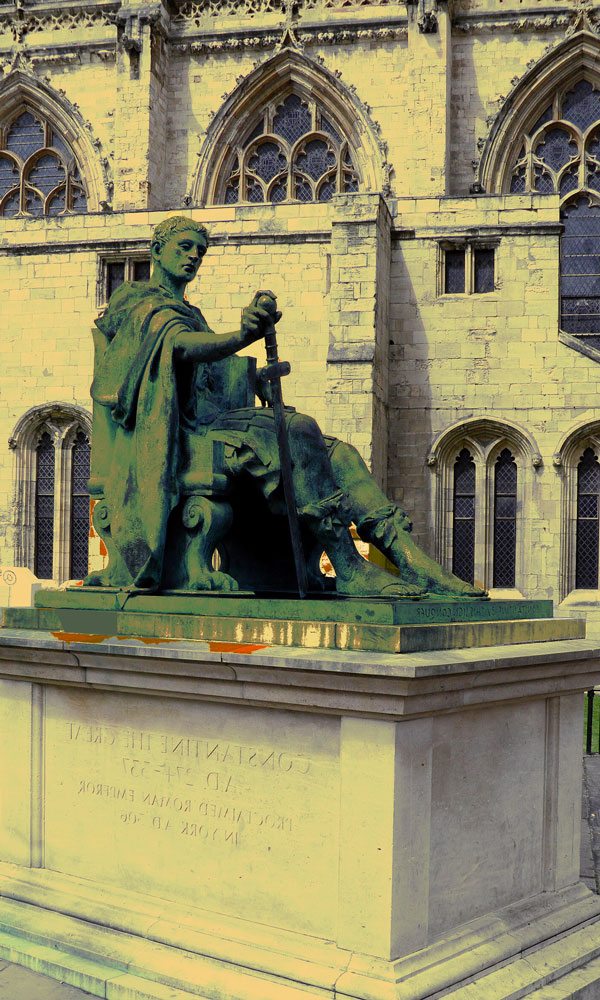 All these proto-Christianisms were mystery cults*. The means for humans to become equal with their god.
*Mystery religions, mystery cults, sacred mysteries or simply mysteries, were religious schools of the Greco-Roman world for which participation was reserved to initiates (mystai).
None of these christs claimed to be the only god, because all humans knew how many gods there were. Only the anthropophagous dragon, the god of the Hebrews, had this disgusting claim.
As you can see, there were not only males in this initiatory function: we must count with the goddesses Ana, Ama, Isis, Athena… That’s why I mentioned “christnesses”.
The holy anointing of Isis, a true initiation to enlightenment, was made neither of water nor oil. It was lightning that gave it.
Lightning governs everything.
And my benefactor, the late Jean-Claude Flornoy, received this baptism by lightning on the banks of the Mayenne in 1989. This initiate is therefore an authentic son of Isis.
The Christianisms are not two, they are ten, they are a hundred. This is not surprising. Taught to humans by the former gods, they succeeded each other over a period of several millennia. Neo-Christian has also evolved a lot since Constantine, emperor of the Eastern Roman Empire, and true founder of neo-Christianism.

The Jesus Case
- All Unique Gods
- Another Side of Jesus
- The Conversion of Zacchaeus
- Aesus Christus
- Another Side of Virgin Mary
- Jesus and Magic
- Jesus And His Models
- Unlikely Jesus
- Jesus Missing
- Simon The Magician
- Enoch And Jesus
- Orpheus Christ
- Osiris And Jesus
- The Hidden Agenda Of Zacchaeus
- Lucifer Christ
- Dionysus Son Of God
- Double Dionysus
- Christianism and Mithraism
- Chrism Unveiled
- Beneath The Holy Grail
 Chrism Unveiled